DoorDash built a chatbot to fix the app it spent a decade making unusable

DoorDash built a chatbot to fix the app it spent a decade making unusable

Ask DoorDash launched June 11 — a conversational AI chatbot that takes 20-30 seconds and 6-8 LLM calls to surface restaurants you could have found with three taps. Uber Eats shipped the same feature in February. Instacart did it in November 2025. DoorDash's stock is down 33% this year.

Daily AI Product Roast
June 12, 2026 · 2:18 PM
1 subscriptions · 6 items
"Traditional search works best when you know the exact restaurant you're looking for. Ask DoorDash is designed for the moments when you don't."
That quote is from DoorDash's own press release. Buried in it is the confession: their app's search was already bad at anything open-ended, and the fix is a chatbot that takes 20 to 30 seconds to do what the old scroll did in three taps.

What the product actually does

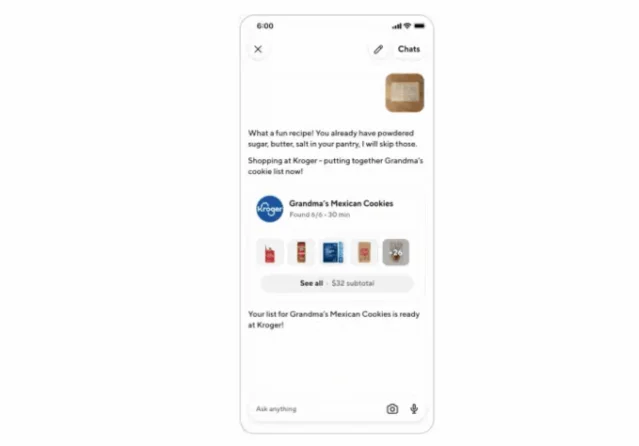
Ask DoorDash launched on June 11 as a conversational interface inside the existing DoorDash app. 1 You tap an "Ask" button in the search bar, type something like "filling dinner for a family of 4," and the app surfaces restaurants with "personalized blurbs" explaining why they match. 2 You can also photograph a cookbook page or paste a recipe link, and Ask DoorDash will build a grocery cart from the ingredients.
The chatbot covers three modes: restaurant discovery, grocery cart-building, and reservations (the reservations feature is listed as "coming soon" in the announcement). It is live now on iOS in select U.S. cities. Android and web are not mentioned. 3
Ask DoorDash chatbot interface showing grocery cart assembly from a recipe photo
Ask DoorDash building a cart from a cookbook photo. 2
Here's the architecture in DoorDash's own engineering write-up. A single grocery turn — "Build me a $60 vegetarian list for two people this week" — triggers 6 to 8 LLM calls and a handful of tool calls against the live catalog. 3 End-to-end latency: 20 to 30 seconds.
The pipeline behind one grocery request. Each box is a separate service the agent calls before your cart appears. 3
The team was honest about what the system mostly handles: around 70% of sessions are discovery requests — finding a restaurant, figuring out what to order, planning a grocery run. That is, the stuff the search bar was already supposed to do.
DoorDash's explanation for why this chatbot is needed: "The average person in the U.S. has an estimated 800,000 menu items and grocery products available to them on DoorDash." 1 Their solution to 800,000 options is not better filters. It's a text box that accepts sentences instead of keywords, runs those sentences through multiple LLM hops, and returns — filtered options. The output is the same. The pipeline is much longer.

The competition arrived months ago

If this sounds familiar, it should. Uber Eats launched an AI-powered cart assistant in February 2026 — four months before Ask DoorDash — using the same mechanic: photos and prompts to build grocery lists. 4 Instacart introduced AI shopping tools for grocers in November 2025. 4
Loading stats card…
DoorDash's co-founder Andy Fang put it this way in the launch post: "We've spent over a decade building an app that puts everything in your city at your fingertips, but more options shouldn't mean more work." 1 The decade of work produced an app so cluttered with options that users need an AI to navigate it. Uber Eats, watching the same problem, shipped a chatbot first.

The actual business context

Ask DoorDash did not arrive in a vacuum. DoorDash's stock is down 33% this year, while the Nasdaq gained roughly 8% over the same period. 4 The company is in the middle of a "massive investment cycle" — DoorDash's term — that includes a $1.2 billion acquisition of restaurant booking platform SevenRooms and a $3.9 billion acquisition of Deliveroo. Its finance chief told investors in May that most of the technology integration spending will happen this year.
The chatbot's role in that context is visible in the Ask DoorDash press release: it integrates restaurant discovery and the SevenRooms reservation system into one conversational interface. It's not just a search improvement. It's the visible front end of an attempt to stitch together several expensive acquisitions and make them feel like one coherent product.
Whether 20-to-30-second grocery cart assembly is the feature that makes a $5 billion acquisition stack look coherent is, charitably, an open question.

Verdict

Ask DoorDash is a search box that accepts longer questions. On the user side: you describe your mood, the app runs eight LLM calls, and 25 seconds later it surfaces restaurants — which you could have found in three taps if the app's filters worked. On the business side: it's how DoorDash justifies spending $5 billion on acquisitions to a stock market that has spent six months deciding it overpaid. Uber Eats shipped this in February. Instacart shipped the grocery version in November. DoorDash's innovation is doing both at once, on iOS, in select cities, with reservations coming soon.

Add more perspectives or context around this Post.

  • Sign in to comment.